
If your AI-generated characters all sound like the same polite, articulate person wearing different outfits, you’re not alone. It’s the most common problem in AI-assisted fiction — and it has nothing to do with the model you’re using.
The problem is what you’re giving AI to work with. And the fix — a technique I call a character snapshot — takes about 10 minutes and completely changes the quality of AI character development in your novel.
After publishing 22 books and building 200+ novel packages across every genre, I can tell you: this is the single change that makes the biggest difference in how real your characters feel on the page.
The character sheet problem
Most authors give AI something like this before writing a scene:
Character: Maren, 34, bakery owner. Kind, independent, guarded. Grew up in foster care. Loves her dog.
That’s a character sheet. It tells AI what your character is. But AI doesn’t need to know what your character is — it needs to know how your character operates.
With the description above, AI will write Maren as generically kind, vaguely independent, and “guarded” in the most surface-level way possible. She’ll cross her arms a lot. She’ll avoid eye contact. She’ll sound exactly like every other character you’ve prompted with a list of adjectives.
The issue is that adjectives aren’t behavior. And behavior is what makes a character feel real on the page. This is where most AI character development goes wrong — authors describe their characters instead of defining how they function.
What a character snapshot looks like
Instead of a trait list, give AI a short document that describes how the character thinks, talks, and moves through the world. Here’s the same character written as a snapshot:
Maren leads with competence. She shows care through practical action — fixing a fence, showing up early, solving a problem no one asked her to solve. She avoids direct emotional statements and deflects vulnerability with subject changes or dry humor. When she’s overwhelmed, she goes quiet — not cold, just still. She doesn’t cry in front of people.
The one exception is children. She’s disarmed by directness from kids because they don’t perform the way adults do.
She speaks in short, direct sentences. She doesn’t ramble or over-explain. When she’s angry, she gets quieter, not louder. When she’s attracted to someone, she finds reasons to leave the room.
Her central wound is abandonment — not dramatic, just the steady, grinding kind. She was moved between four foster homes before she aged out. She doesn’t talk about it. What it left her with is a deep belief that staying means getting left, so she builds a life where she never has to depend on anyone.
Give AI the first version and you get a pleasant, forgettable woman. Give AI the second version and you get someone who feels like a specific human being.
The difference in output is immediate. AI will actually write her doing these things in scenes — leaving the room when things get tender, deflecting with a joke when someone gets too close, showing up at 5am to help without being asked. That’s the leap in AI character development that no amount of adjectives can produce.
The five elements of a strong character snapshot
You don’t need all five for every minor character. But for your leads, hit them all.
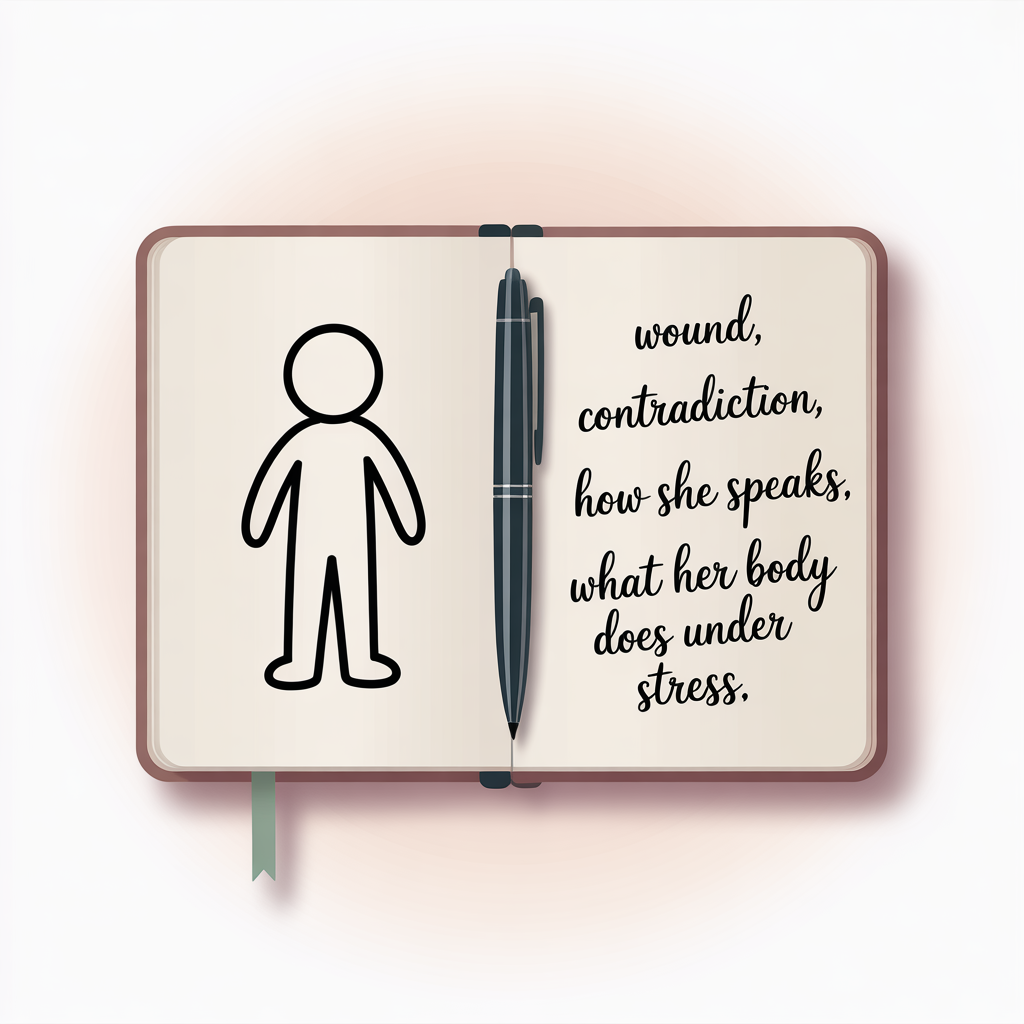
How they show emotion — not what emotions they have. Skip “she’s compassionate.” Instead: “She shows care by doing things for people without being asked, but she physically stiffens when someone thanks her for it.” That single sentence gives AI more to work with than a paragraph of personality traits.
How they speak. Short sentences or long ones? Do they deflect questions? Answer questions with questions? Use humor as armor? Swear when they’re nervous? Trail off mid-thought? Talk too much when lying? One character who “never finishes a sentence when she’s lying” will sound different from every other character in your novel — because AI has a specific speech behavior to execute, not a vague personality to approximate.
What their body does under stress. This is the element that elevates AI prose from generic to specific. “She touches her mother’s necklace when nervous.” “He rolls a coin across his knuckles when he’s thinking.” “She stops blinking when she’s scared — just goes completely still.” These physical tells replace the “she felt nervous” sentences that AI defaults to. If you’ve read our post on how to write better AI prompts for fiction, this is the character-level version of that same principle — specificity over generality.
Their central wound and how it distorts their behavior. Not just “he has trust issues.” Try: “His father left when he was twelve with no explanation. What it gave him is a compulsion to be the one who leaves first. He ends friendships before they go wrong. He’s generous with strangers and withholding with people he loves — because the closer someone gets, the more it’ll hurt when they disappear.” That’s not backstory the reader sees on the page. That’s the engine that drives every decision the character makes. AI will use it to inform behavior in scenes without dumping the exposition.
Their contradiction. Every interesting character wants two things that conflict. She wants love but pushes everyone away. He wants justice but keeps protecting the person who’s guilty. She wants to stay in this town but can’t stop applying for jobs in other cities. Give AI the contradiction and it writes internal conflict naturally. Without it, AI writes characters who move through the story in a straight line — which is why they feel flat.
AI character development across genres
This technique isn’t romance-specific. Here’s what a strong character snapshot looks like across genres.
Cozy mystery sleuth:
Lyla notices things other people miss — not because she’s brilliant but because she’s nosy and she can’t help herself. She asks one too many questions in every conversation. She apologizes for prying and then immediately pries further. She speaks in run-on sentences when she’s excited about a theory. She goes quiet and methodical when she’s actually scared. Her contradiction: she wants a peaceful, quiet life running her bookshop, but she cannot leave an unanswered question alone.
Thriller protagonist:
David is controlled. Deliberate. He plans three steps ahead and speaks like every word costs money. Under pressure, he gets calmer — almost unnervingly so. He doesn’t raise his voice. The tell is his hands: when he’s afraid, he puts them in his pockets so no one sees them shake. His contradiction: he operates alone by choice but keeps a burner phone in his desk drawer with one number saved — someone he hasn’t called in two years but can’t bring himself to delete.
Romantic suspense lead:
Kira projects confidence like armor. She makes eye contact a beat too long. She answers personal questions with questions. She’s hyperaware of exits in any room — not because she’s paranoid, but because she learned young that knowing where the door is means you’re never trapped. She’s funny — genuinely funny — but the humor always has an edge. Her contradiction: she craves safety but is only attracted to people who feel dangerous.
Drop any of these into your system prompt or paste them before a scene, and the character immediately starts behaving like a person instead of a placeholder. That’s the real unlock in AI character development — giving AI enough behavioral specificity that it can’t default to generic.
How this connects to a story codex
A character snapshot is one piece of a larger document called a story codex — a comprehensive reference that gives AI everything it needs to write your novel consistently. The codex includes character snapshots for your entire cast, plus relationship dynamics, setting details, voice rules, and genre conventions.
If the character snapshot fixes how individual characters feel, the codex fixes how your entire novel feels. Characters stop contradicting themselves between chapters. The tone stays consistent. Secondary characters behave like people with their own agendas instead of furniture that exists to serve the protagonist.
We go deeper on the full codex structure in What Is a Story Codex (And Why AI Writers Need One).
Try it right now
Answer these five questions for your main character:
- How do they show care? (Through action, words, gifts, or silence?)
- How do they speak? (One quirk is enough.)
- What does their body do when they’re stressed or scared?
- What’s the wound, and how does it distort their behavior today?
- What two things do they want that conflict with each other?
Paste the answers before your next scene prompt. You don’t need to be fancy about the formatting — just a paragraph or two in plain language. AI doesn’t need structure. It needs specificity.
This is one of those changes where the first time you try it, you’ll wonder why you ever prompted without it.
Want the complete foundation?
This character snapshot technique is one piece of the system I use to build complete novel foundations. I put together a free 14-page workbook that breaks down the full approach — from concept to complete first draft.
→ Download the free Plot to Published workbook here
And if you want the entire foundation built for you — including detailed character snapshots, relationship dynamics, chapter outlines, AI-ready prompts, and genre-specific conventions — our Plot & Prompt packages come ready to write. Each one is built on current market data and sells exclusively to one author.