
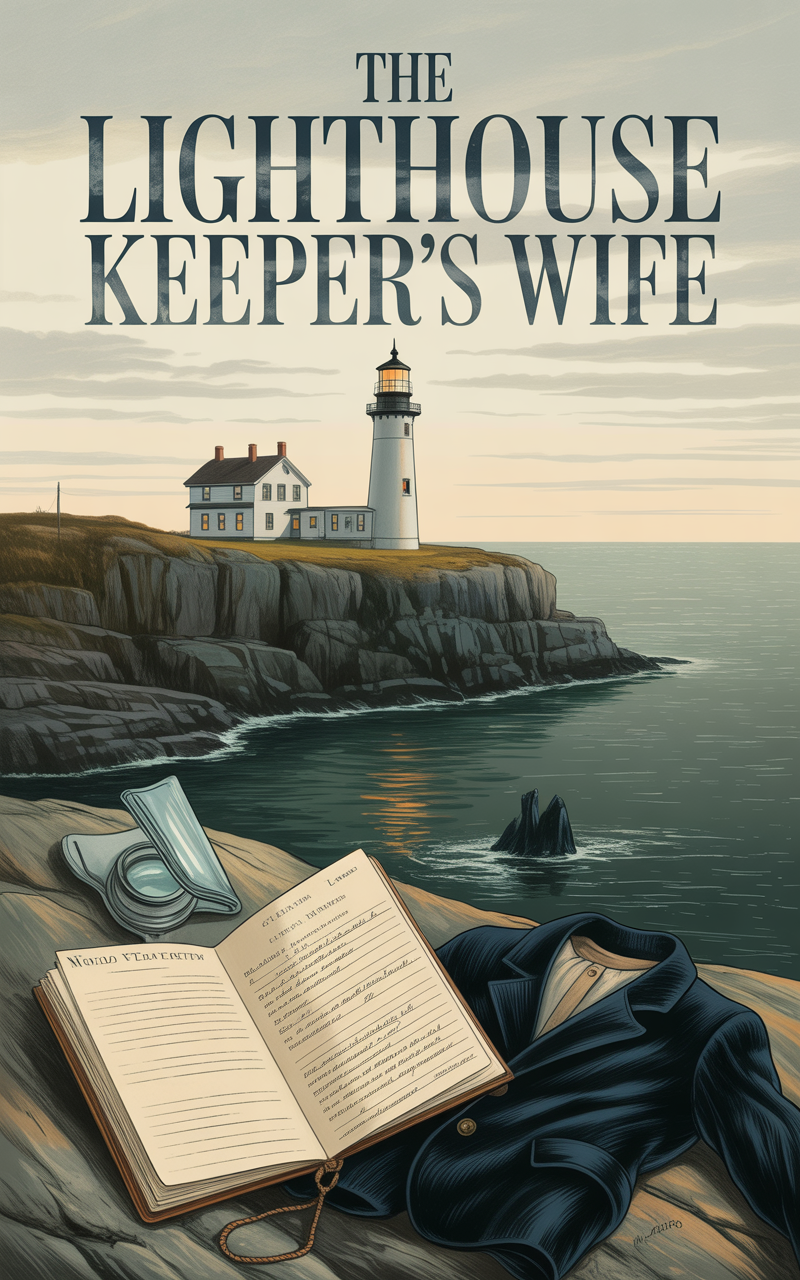
THE LIGHTHOUSE KEEPER’S WIFE
Coastal Maine, November 1875. Three bodies have washed up below Heron’s Point Light. The Revenue Cutter Service says no ship went down in these waters this week. Elara Gale knows her lens housing was clean on the morning after the wreck — and a clean lens housing proves the light was dark.
Elara has kept the Heron’s Point lighthouse for seven years. Her husband holds the government appointment; she holds the wick, the lens, the log, and the specific knowledge of someone who has watched these waters from this tower every night for seven years. She knows the Widow’s Tooth reef and the shipping lanes and what happens when a vessel comes through these waters without a light to fix on.
When the first body washes up on her morning inspection of the rocks — a sailor with no ship’s markings, and no debris field that would indicate a recent wreck — the Revenue Cutter Service’s response is that their records show nothing in these waters that week. Elara goes back to the lighthouse and reads the log entry for the night of November 12th, kept by her assistant Samuel Orin. Seas three to four feet, northeast wind, light maintained without interruption. She cleans the lens housing. It is clean. A sea of three to four feet in a northeast wind on this headland would have left salt residue on the lens housing by midnight. The lens housing was clean because the spray never reached it. The spray never reached it because the light was not running.
The ship was the Mary Adelaide out of Portland, and she was carrying financial documentation in a fraud case against one of the most respected men on the Maine coast — a man who has appeared in the village, with great concern and great interest, every day since the bodies began washing in.
Elara has her log. Her lens. Seven years of knowing these waters. And the absolute knowledge that the light was her responsibility and what happened in its absence was not an accident.
Tropes:
- Female Amateur Sleuth (Lighthouse Keeper’s Wife — True Keeper)
- Victorian Maritime Setting (1875 Maine Coast)
- Bodies Washing Ashore from a Wreck That Didn’t Officially Happen
- Professional Expertise as Investigation Engine (Lens Housing Evidence, Log Analysis)
- Deliberate Wrecking as the Crime (Historical Maritime Horror)
- The Most Respected Man in the Community Is the Killer
Heat Level: Sweet/Clean
Why it sells:
- Victorian coastal Maine is a dramatically underused setting for historical mystery relative to the British coastal mystery market — the lighthouse, the rocky coast, the maritime community, the specific world of the 1875 Lighthouse Board and Revenue Cutter Service provide a rich atmospheric container that readers of Maisie Dobbs and comparable series will find genuinely fresh
- The lighthouse keeper’s wife as the true keeper is the book’s central structural innovation — Elara has been doing the work for seven years while her husband holds the title; her investigation is an extension of that work; the case is built from the lens housing and the log, not from social observation, which gives this mystery a genuinely unusual investigative method
- Deliberate wrecking is one of the most horrifying historical crimes available to the genre — seven men died because someone extinguished the light; the case is not cozy and the story treats the deaths accordingly, which creates the moral weight that distinguishes literary historical mystery from the decorative variety
- The Josiah relationship adds structural depth without becoming a subplot — his discomfort with the investigation (it will expose how the lighthouse is actually operated), his eventual offer to put her name on the log officially, and her response create a marital arc that serves the story’s theme (the person who does the work creates authority that can’t be fully suppressed) without competing with the mystery