
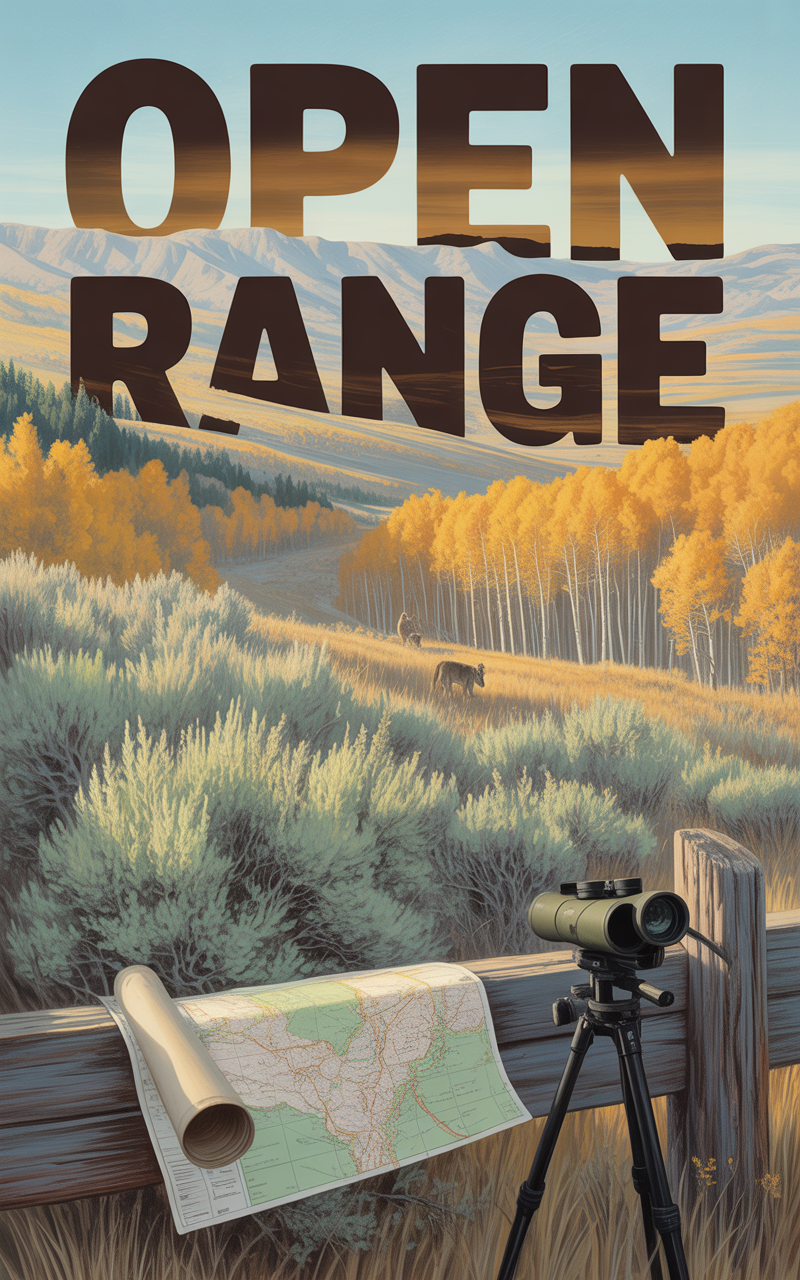
OPEN RANGE
Imry Orvall has been in Crestline Basin, Wyoming for seven months. She knows this wolf pack individually — the alpha female by a torn left ear, the alpha male by the unusual dark coloration across his shoulders, the juvenile by the specific boulder he uses to cross the creek drainage, every morning, the same way. She has been calling them by field designations in her official reports and by descriptive names in her private field notebook and managing the gap between those two things as best she can. She is a federal wildlife biologist and the methodology requires objectivity. She has been in this Basin for seven months. The methodology is losing.
Her study has a problem. Three miles of primary habitat on the property of Kestrel Mayne — a third-generation cattle rancher who testified against the reintroduction program at the county commission, refused her monitoring equipment, and is by all accounts the program’s most technically grounded opposition voice — sit between her monitoring points eleven and fourteen as a white corridor on her movement map. Without that segment, her analysis has wolf entry and wolf exit and no middle. The study is incomplete.
What Imry doesn’t know: Kestrel Mayne has been reading every one of her public monitoring reports since December. He has been cross-referencing her pack movement data against his cattle records and his own trail cameras and his two years of independent analysis. He has built an overlay map that shows the Basin’s predation ecology at a resolution that neither the program nor the opposition has produced. The map shows the corridor function is real. The map also shows something he has been carrying for three years: the predation event that became the opposition’s strongest argument was a domestic dog, not the Crestline pack. He looked at the evidence the morning after it happened and knew what had done it and said nothing because the community was building its case on the event and the moment for saying it had passed and then two years had passed.
When she drives to his ranch to ask who has been making unexplained assists to her study, he confirms he’s been reading the reports. When she asks what he did with the data, he brings her a map.
What they build together from their two angles — her seven months of daily pack observation, his fifteen years of daily land knowledge — is more complete than what either had alone. The pack’s survival during the program’s decision period depends on both of them being honest about everything they know.
The alpine aspen drainage is gold in October. The Basin is enormous and specific. Two people have been paying exact attention to the same place from opposite sides, and the picture only makes sense when they’re both looking at it.
Tropes:
- Opposites Attract
- Enemies-to-Allies
- Hidden Cooperation (he’s been reading her data for months)
- Wildlife / Wolf Conservation Theme
- Cowboy Hero
- Slow Burn
Heat Level: Moderate
Why it sells:
- Wildlife romance as an emerging and under-served niche — readers who loved The Simple Wild and nature documentaries and have been looking for romance in this space will find this book and keep it; the wolf pack is specific and individual and the reader will know Torn-Ear and dark-shoulder and creek-boulder the way Imry knows them
- The hidden cooperation twist — he has been reading her data for months before she knows it; this subverts the standard enemies-to-allies structure in a way that feels both surprising and inevitable; it’s not antagonism, it’s undisclosed interest at the scale of an entire data analysis
- Mutual intellectual respect as the romance’s primary engine — their attraction is grounded in the specific recognition of comparable sustained attention; he knows this land the way she knows this pack, and the moment each recognizes the other’s depth of knowledge is the moment the romance becomes possible
- The domestic dog misattribution as earned complexity — the thing he’s been carrying for three years is not a dramatic secret, it’s a human-scale failure of honesty in a community context; when he finally says it, it costs him something real and the cost is legible to the reader
- Wyoming Basin setting as market differentiator — high-elevation sagebrush and aspen country in the southern Wind River Range is visually and atmospherically distinct from every other setting in this collection and in the broader western romance market; readers who love landscapes will find this one