
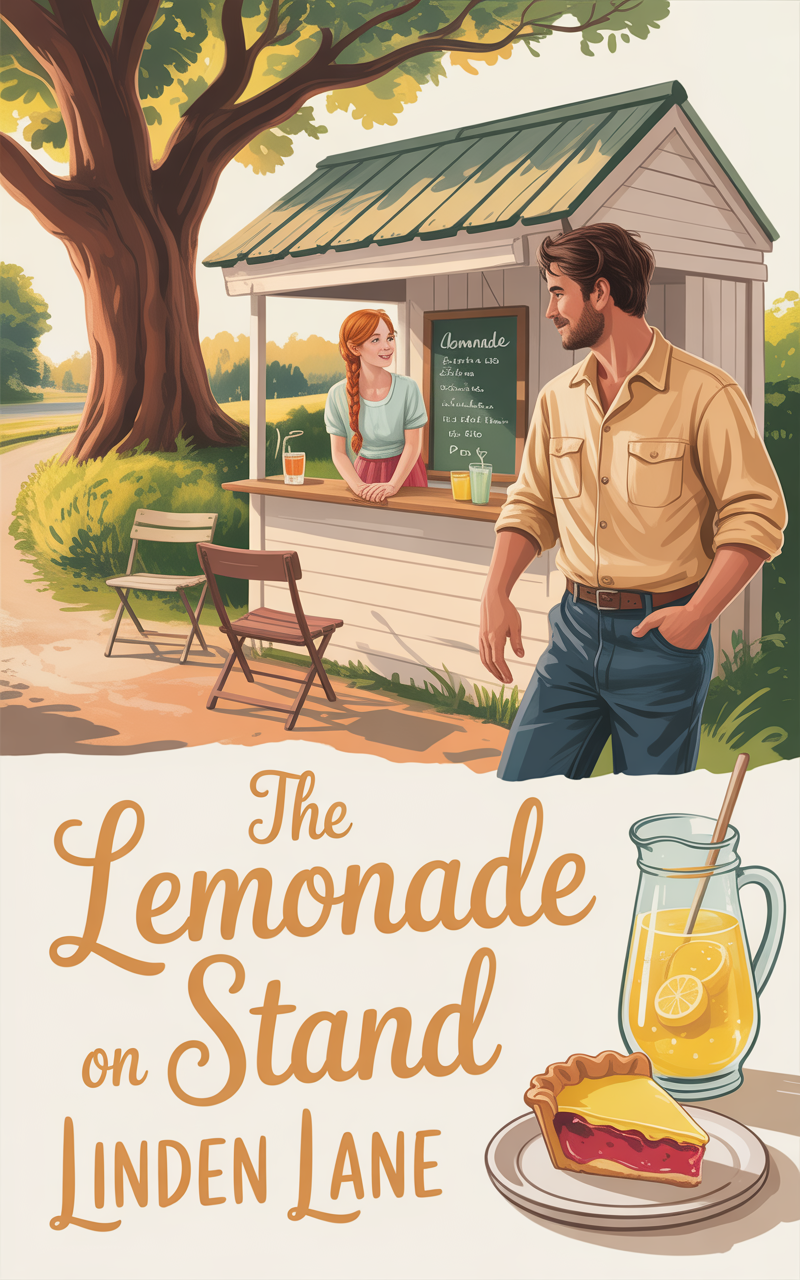
THE LEMONADE STAND ON LINDEN LANE
Sweet/Clean Small Town Romance
Margot Bellamy spent seven years in New York building a life big enough to stop missing the one she left behind. Then her grandmother died and left her a lemonade stand — and a four-week deadline to figure out what to do with it. She came to Cresthollow to sell. She did not plan on Callum Harte.
He’s the carpenter who’s been maintaining Mae’s stand for three years, knows every regular’s order, and has strong feelings about what happens to it next. He’s also been using Mae’s barn as his workshop. He never mentioned that part.
The more time Margot spends behind that counter, the harder it gets to pretend she doesn’t know exactly what she’d be selling.
One rebuilt sign. One rooster with a grudge. One thing she didn’t expect to want.
Tropes:
- City girl returns home
- Grumpy/sunshine
- Slow burn
- Found family
- Reluctant inheritance
- Animal Sidekick — Felix the rooster; aggressively territorial, eventually won over by sunflower seeds
- Slow-Burn Romance — one kiss in Chapter 21, earned across 28 days of lemonade and two people better at doing than saying
Heat Level: Sweet/Clean
Why it sells:
- Small-town romance top-20 titles average 85–140 sales/day with a 1:3.2 sales-to-comp ratio — the inherited-property hook and women’s fiction emotional core enable dual placement and pull readers beyond the core romance audience.
- The lemonade-stand premise is visually distinct and underrepresented — while inherited houses and farms dominate the category, this setting carries immediate nostalgic shorthand and strong cover potential.
- Grumpy/sunshine + slow burn is the top-performing trope combo in sweet/clean romance, but the black moment here is a real asymmetry of trust, not a fixable misunderstanding — built for the reader who’s tired of black moments a single conversation would resolve.
- Women’s Fiction > Friendship offers a strong secondary placement — K-Lytics shows a 1:2.8 sales-to-comp ratio with high reader loyalty and series read-through.
- The summer setting and festival climax give this a strong May–August promotional window — but the homecoming-and-grief emotional core keeps it evergreen year-round.