
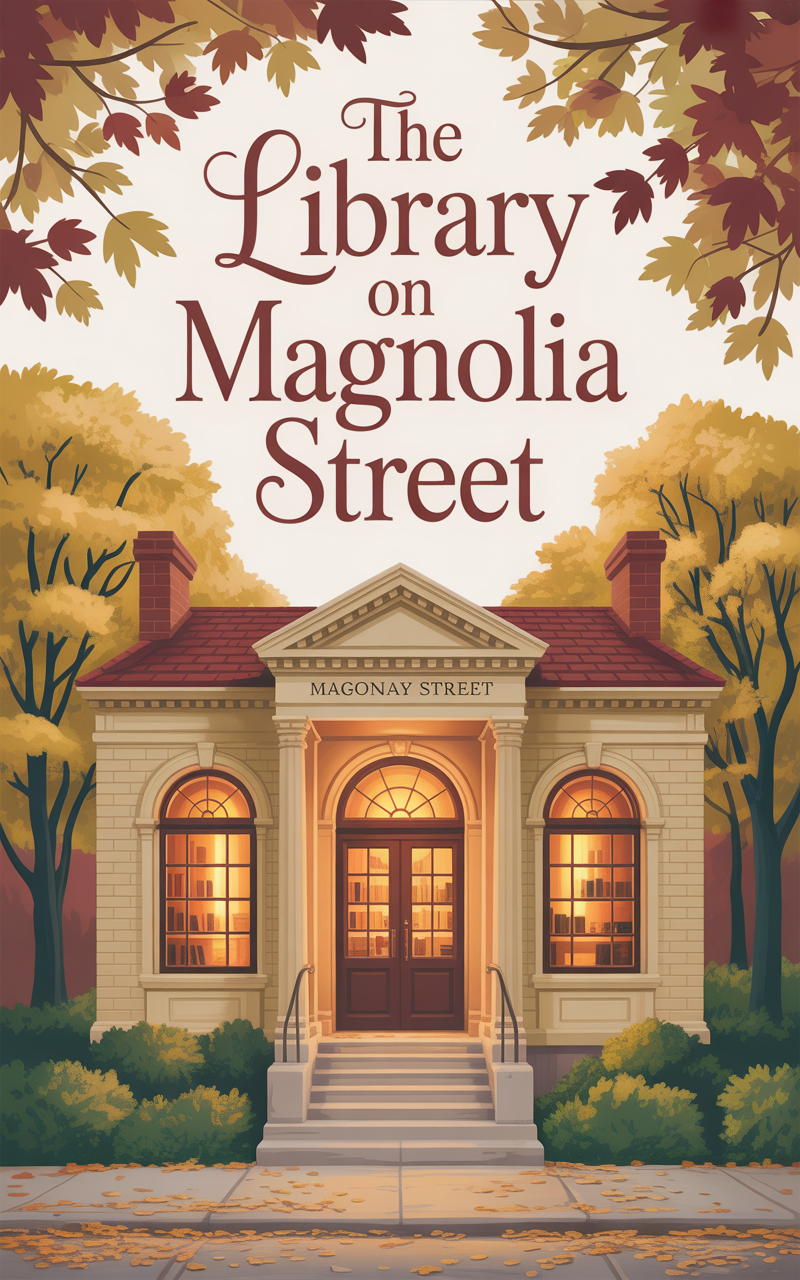
THE LIBRARY ON MAGNOLIA STREET
Sweet/Clean Small Town Romance
Josephine Hale has been the sole librarian at the Magnolia Street branch for eight years. She knows every patron, every program, and every argument for keeping the branch open when the county’s evaluation comes. What she doesn’t plan for is the evaluator being Declan Marsh — the boy who asked her to the Spring Formal at fifteen on a dare, watched her find out, and left Millhaven three months later. He walks through the door on a Tuesday in October and doesn’t recognize her. She recognizes him immediately. She decides, in approximately two seconds, not to say anything.
Six months of evaluation follow. Declan has a framework, a notebook, and an increasingly insufficient set of metrics for what this library actually is. Josephine has eight years of programming data, eleven homebound patrons whose names she knows, a seed library the county doesn’t fund, and a fifteen-year grudge she’s been using as a reason not to reach for anything outside the building she’s been protecting. Both of them are going to have to put something down before April.
Some libraries hold more than books. Some things take six months to say.
Tropes:
- Second-chance romance
- He doesn’t remember her
- Workplace / professional power dynamic
- Slow burn
- Small-town drama
- Animal Sidekick — N/A
- Slow-Burn Romance — one kiss in the stacks in Chapter 21, earned across six months of evaluation meetings, one snowstorm, and a book club that consistently runs twenty minutes over
Heat Level: Sweet/Clean
Why it sells:
- Librarian heroines and library settings are among the highest-converting archetypes in sweet/clean romance browse — library settings generate strong impulse discovery and reader identification, consistently outperforming comparable workplace settings in sweet/clean specifically.
- The “he doesn’t remember her” variant of second-chance is underused and potent — it removes the standard reunion-argument structure and replaces it with a slower, more psychologically layered reveal that readers find genuinely surprising; the recognition gap is a structural engine with no close comparisons in the current category.
- The institutional stakes (the library’s survival) give the workplace dynamic real consequence — Declan’s evaluation role is not a contrivance; it creates pressure that is separate from the romance and makes the professional tension feel earned rather than manufactured.
- Second Chance secondary placement opens a strong loyalty category — K-Lytics shows ~11,500 competing titles with a 1:2.4 sales-to-comp ratio, with high reader loyalty and repeat-purchase behavior.
- The autumn-through-spring timeline gives this strong fall launch potential — the October–April arc, Carnegie library building, and literary tone position it distinctly against the summer-setting romances that dominate the category.