
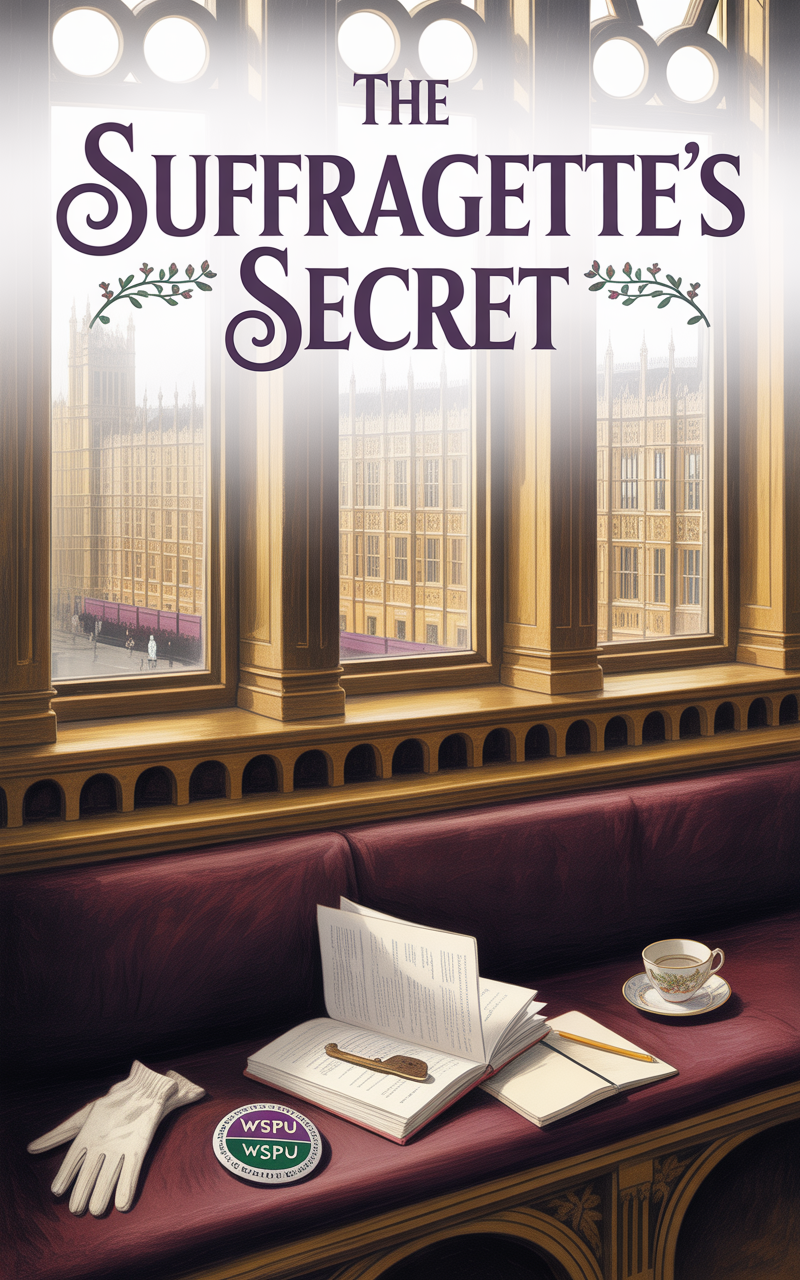
THE SUFFRAGETTE’S SECRET
London, November 1912. The women’s suffrage vote begins at eleven o’clock. At half past six, WSPU organiser Violet Ashdown finds their most important patron dead in the Strangers’ Gallery — and the tea cup is on the wrong side.
Lady Constance Beaumont was the reason Violet gave up her family, her respectability, and any prospect of a conventional life for the suffrage movement. She was the woman who told Violet that anger was an asset and that the law was a machine — you just had to find the lever. Now she’s slumped in her usual gallery seat with yesterday’s programme in her lap and a cold cup of tea at her right hand, and the police are calling it heart failure, and Violet knows — because she has attended enough meetings with Lady Constance to know that Lady Constance always held her tea in her left hand — that the cup has been moved.
She has twenty-four hours. The gallery was locked overnight; there are four key holders. Every one of them has something to hide. There is a diary in the dead woman’s coat pocket that belongs to someone else. There are financial documents hidden behind the parliamentary record of 1908. There is a militant organiser concealed in a storage room who was with Lady Constance at midnight and won’t say why. There is a chemist’s analysis that confirms what Violet has suspected since she first touched the cup. And there is Inspector Holt — a detective who is not going to officially credit Violet with anything but who keeps noting things he doesn’t write down.
The suffrage bill will fail. It failed historically, and this novel doesn’t pretend otherwise. But Lady Constance Beaumont deserved the truth, and Violet Ashdown is going to find it before London moves on.
Tropes:
- Female Amateur Sleuth (Suffragette Organiser)
- Locked-Location Mystery (Strangers’ Gallery, Houses of Parliament)
- Political Backdrop (1912 Women’s Suffrage Vote)
- Fair-Play Puzzle Mystery
- Cautious Male Official Ally (Inspector Holt)
- Edwardian Class Dynamics
Heat Level: Sweet/Clean
Why it sells:
- Edwardian women sleuth series are the historical mystery category’s most reliable commercial engine — Maisie Dobbs, Daisy Dalrymple, Bess Crawford consistently dominate the bestseller lists, and the market actively seeks new entries in the same register; a suffragette protagonist at the movement’s most dramatic historical moment is a genuinely fresh take on a proven commercial structure
- The 24-hour compressed timeline creates urgency that the women’s sleuth subgenre often lacks — most Edwardian mystery series use a looser investigation structure; the vote deadline gives this book the pace of a locked-room puzzle within the atmosphere of a period character study
- The Houses of Parliament setting is inherently ironic and historically loaded — the place where women’s rights are being debated is also the place where a woman was killed to prevent the movement from doing what it was there to do; this is the kind of premise that generates word-of-mouth
- The suffrage movement provides a ready-made reader community — women’s history readers overlap substantially with historical mystery readers, and a novel that takes the suffragette movement seriously as its primary context (rather than as decorative backdrop) will find enthusiastic readers in both communities