WHAT’S INSIDE THIS PACKAGE
⭐️ Story Premise — high-concept pitch, elevator pitch, and K-Lytics market validation with triple-category positioning (Contemporary Romance, Clean & Wholesome, Women’s Fiction > Friendship) and competitive analysis against Garmus, Joyce, and Osman
⭐️ Complete Codex — full story bible with main characters (Cecily and Harlan, both with complete backstory, internal landscape, and extended voice examples), supporting cast of 6 including the deceased spouses rendered as fully specific characters through memory, working British allotment setting with seasonal accuracy and sensory detail, chapter-by-chapter timeline across one full growing season, dual first-person voice system with distinct verbal patterns for Cecily (precise, dry, librarian-inflected, talks to her plants) and Harlan (spare, Cork-cadenced, tastes things before commenting, goes still when thinking), closed-door intimacy guidance, and series seeds for all 4 Linden Road Allotments books
⭐️ Chapter-by-Chapter Outline — 26 chapters + epilogue with full scene breakdowns (3–5 bullet points per scene), emotional beats, key dialogue anchors, sensory detail instructions, ending hooks, and chapter-to-chapter connections across the complete arc from March planting to the following spring
⭐️ AI-Ready Chapter Prompts — 27 copy-paste prompts (all 26 chapters + epilogue) each with complete voice brief, scene specifics, key dialogue guidance, sensory detail instructions, emotional beat, tone direction, and hook line; includes specific guidance for the central disclosure scene, the quiet black moment, and the grand gesture
⭐️ Marketing Copy — Amazon listing with 2 categories and 7 keywords, back cover copy, 50-word short description, Instagram feed post with hashtags, 5-slide Instagram Story sequence, Facebook post, newsletter announcement with 3 subject line options, 4 reader magnet concepts with landing page copy, comp title guidance, reader targeting with platform-specific notes, series marketing copy, and Ideogram cover prompt calibrated to the later-in-life sweet romance market
⭐️ Full Implementation Guide — step-by-step instructions from first draft to publication including pricing strategy ($3.99 launch recommendation with rationale), cover direction specific to the later-in-life and clean romance market, and series readthrough strategy for The Linden Road Allotments
One buyer. One story. Exclusively yours.
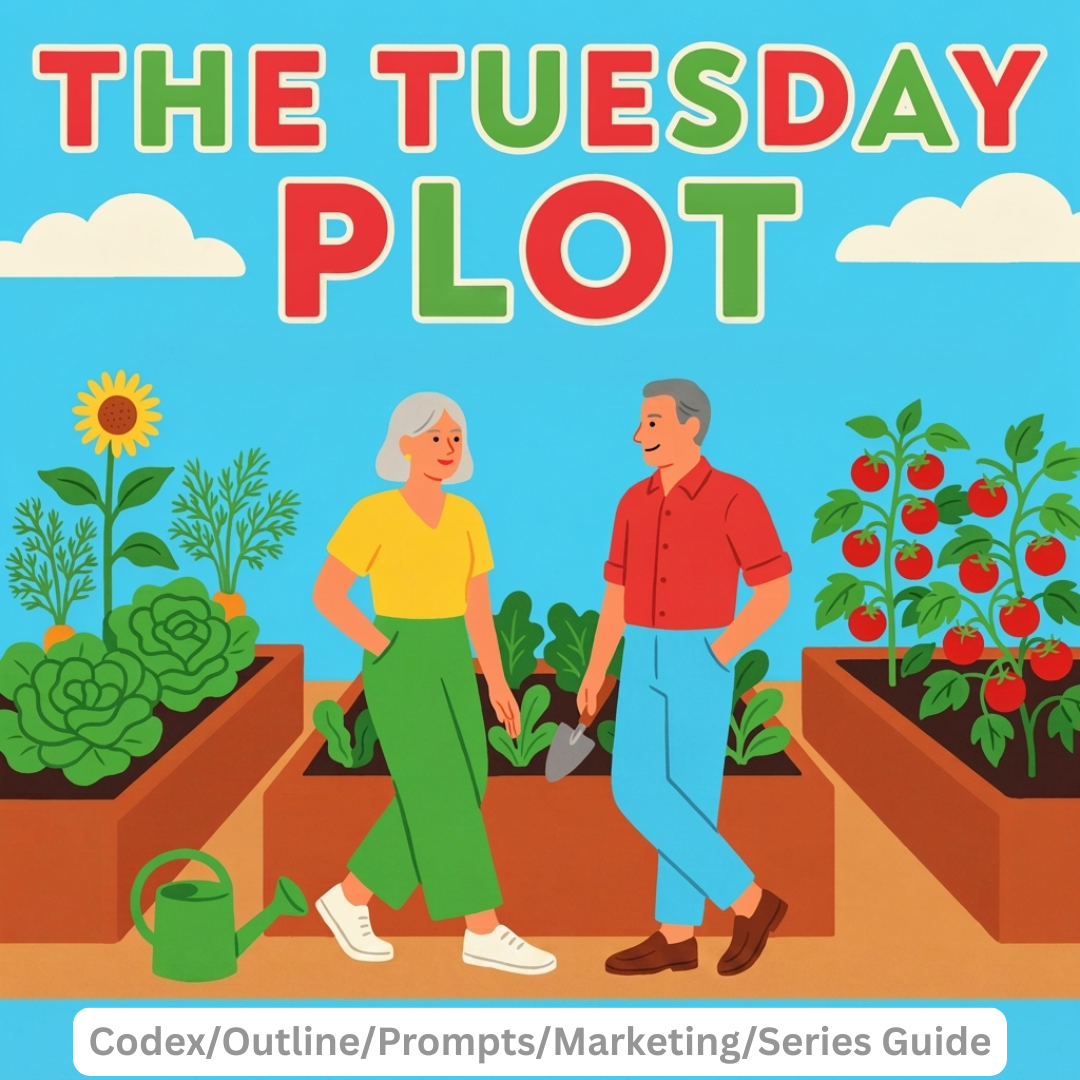
THE TUESDAY PLOT
Cecily Vane spent thirty-one years married to a man who was very good at plans and somewhat less good at starting them. The allotment plot is a perfect example. Edmund paid for it every year, sketched out what he’d grow, bought seeds that sat in their packets through eleven consecutive springs, and left behind a ring-bound binder full of printouts when he died. In March, eight months after she retired and three months after the funeral, Cecily claims the plot. She arrives with her own binder. She has never grown anything. She is going to do this right.
The man on the adjacent plot tells her she’s planting her courgettes too deep.
He is correct. He is a retired chef named Harlan — sixty-seven, widowed eighteen months, the most immaculate plot at Linden Road Allotments, and an opinion about everything she does. He offers corrections the way other people offer weather observations: flatly, without much investment in whether she takes them. She takes them. She just doesn’t let him see that she does.
Before Cecily can get through a single growing season without either murdering her courgettes or developing complicated feelings about the man who keeps saving them — there is the night of the late frost where he covers her seedlings and pretends the wind did it, a shed in May rain where they each say the other’s dead spouse’s name for the first time, sandwiches she definitely did not make too many of, a notebook she finds in the pocket of Edmund’s old jacket with a note at the back in his handwriting that says C would love this if she ever agreed to get her hands dirty, a late August evening where neither of them meant to stay past sunset and both of them say the truest thing they’ve said to another person in years, and the question of whether being allowed to want something new means you never needed what you had.
Cecily has spent a year managing grief like a research problem, keeping Edmund present in every decision, telling herself the plot is for him. Harlan has spent eighteen months arranging his life to require nothing from anyone, running the most orderly quarter-allotment in the county, and not cooking. A single growing season — March planting to September harvest — is about to undo both of them.
Sweet, slow-burn, later-in-life romance, set in a working British allotment across one spring-to-autumn season. The kind of book you read with a cup of tea and then immediately press on someone you love.
WHY THIS WILL SELL
→ Romance > Clean & Wholesome sits at 4.9 sales-to-comp (Hot Mainstream) with 190 estimated daily sales per top 20 title — a proven, high-volume category currently dominated by younger-protagonist titles, leaving the later-in-life segment structurally underserved relative to demonstrated reader demand
→ Later-in-life romance is the most-requested underserved segment in the category — readers consistently cite “older protagonists” as the thing they cannot find enough of; this package is positioned to capture that demand gap at the exact point where search intent has no satisfying result
→ Grumpy/sunshine is a top-3 most-searched romance trope — proven at bestseller levels in younger-skewing titles and almost entirely absent in the 60+ protagonist space, meaning the comp set for this specific combination is nearly empty
→ Dual-category positioning (Contemporary Romance + Clean & Wholesome) with Women’s Fiction crossover — triple-stack discoverability; the community garden setting and found-family element provide genuine relevance to book club buyers, who over-index for word-of-mouth sales
→ Seasonal structure creates two high-conversion marketing windows — spring launch aligned with the book’s opening; September harvest-window push timed to the emotional climax; both windows allow organic seasonal content that doesn’t read as promotional
→ 4-book series architecture compounds revenue from launch — Dot, Pem, and Rosie are all established with warmth and story potential in Book 1, giving readers three reasons to continue before finishing the first book; clean/sweet series show 60–70% readthrough from Book 1 to Book 2 when supporting characters are seeded this way
TROPES:
• Grumpy/Sunshine
• Later-in-Life Romance
• Forced Proximity
• Slow Burn
• Grief Recovery
• Found Family
• Widowed Protagonists
• Unspoken Acts of Care
• Dual POV
HEAT LEVEL: Sweet / Closed Door
Perfect for fans of: Bonnie Garmus, Rachel Joyce, Richard Osman, and Louise Miller