
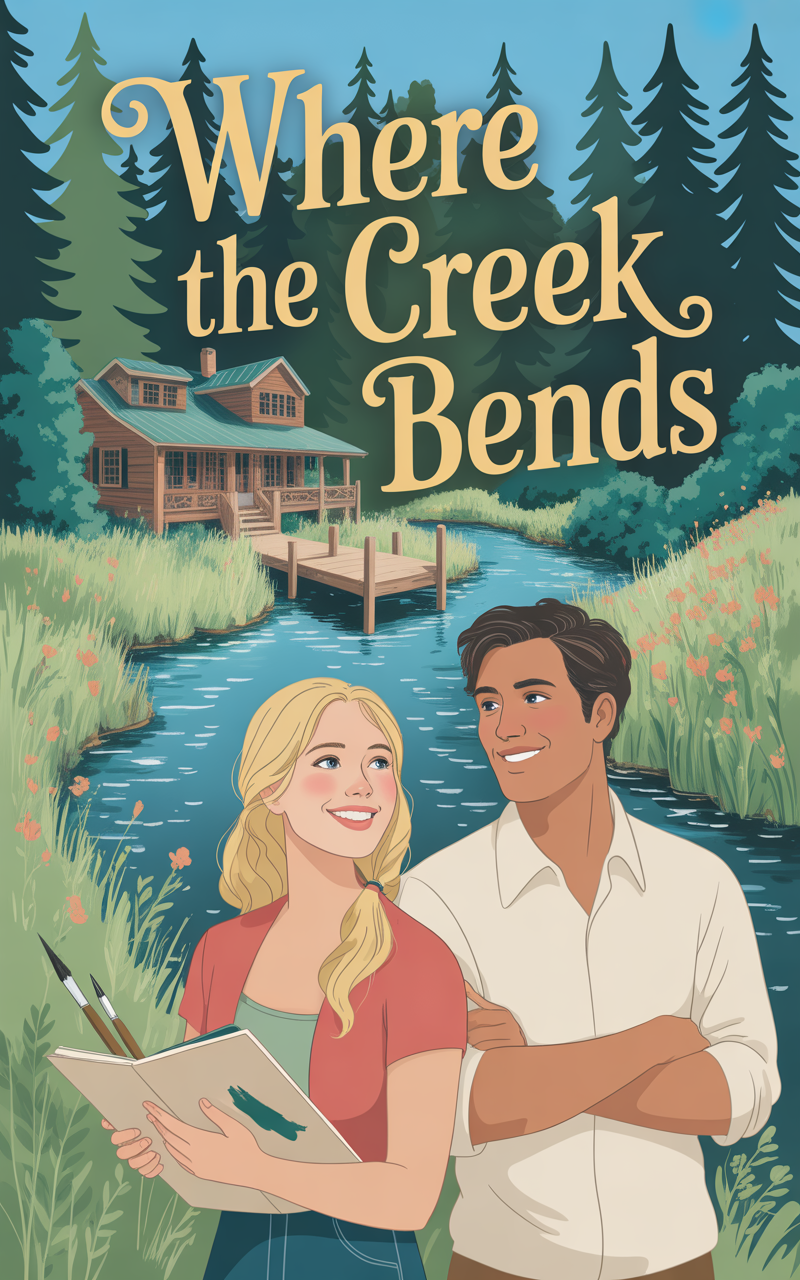
WHERE THE CREEK BENDS
Sweet/Clean Small Town Romance
Olive Marsh illustrates children’s books about animals with complicated feelings. She is not, by any measure, qualified to run a fishing lodge in Vermont. What she has is her late uncle’s vision for what Bent Creek Lodge could be, a summer to figure it out, and an amount of optimism that Reid Calloway — who has kept the lodge running for six years through two floods and one structural emergency — finds genuinely alarming. He had a resignation letter in his pocket when she arrived. She talked him out of using it in the first twenty minutes, mostly by asking him to show her the lodge before he could hand it to her, and he has spent the rest of the summer trying to understand how.
She sees what the lodge could be. He knows what it actually is. Between them: twelve cabins in various states of repair, a pipe that fails at 11pm, a travel blogger who shows up unannounced, and a dock Reid has been building in secret for two years at the bend in the creek. One of them sees in illustrations. The other in structural assessments. Both of them are right. Neither of them has figured that out yet.
Some things take a whole summer to build. Some things are worth the wait.
Tropes:
- Grumpy/sunshine
- Opposites attract
- Inheritance
- Slow burn
- Boss/employee (inverted)
- Animal Sidekick — Bramble, an elderly golden retriever who begins as Reid’s and ends up in Olive’s studio; his defection is a whole subplot
- Slow-Burn Romance — one kiss at dusk on a dock that took two years to build, earned across one summer of renovation chaos
Heat Level: Sweet/Clean
Why it sells:
- Grumpy/sunshine is the single most consistent top performer in sweet/clean small-town romance per K-Lytics trend data — the inverted power dynamic here (she has authority, he has all the knowledge) creates a fresher version of the trope than the standard setup and drives sustained reader satisfaction.
- The fishing lodge renovation premise is genuinely underrepresented — lodges and inns appear as settings but the rebuild-over-a-summer structure creates natural escalating stakes, a built-in deadline, and a setting that visibly transforms alongside the relationship.
- The children’s book illustrator heroine is unlike any other in the category — her visual, observational voice is distinct, her professional lens applied to a practical problem creates both comedy and genuine plot utility, and her sketchbook gives the story a running visual motif that’s cover-friendly and marketable.
- Workplace Romance secondary placement opens a low-competition category — K-Lytics shows ~8,200 competing titles with a 1:2.0 sales-to-comp ratio, the strongest ratio of any romance subcategory.
- The Vermont summer setting has strong seasonal promotional appeal — and the lodge-renovation arc gives this standout potential in a category currently dominated by beach towns and small-town diners.